FarmAssistance
Farm Record Keeping 101: What to Track and Why It Pays Off
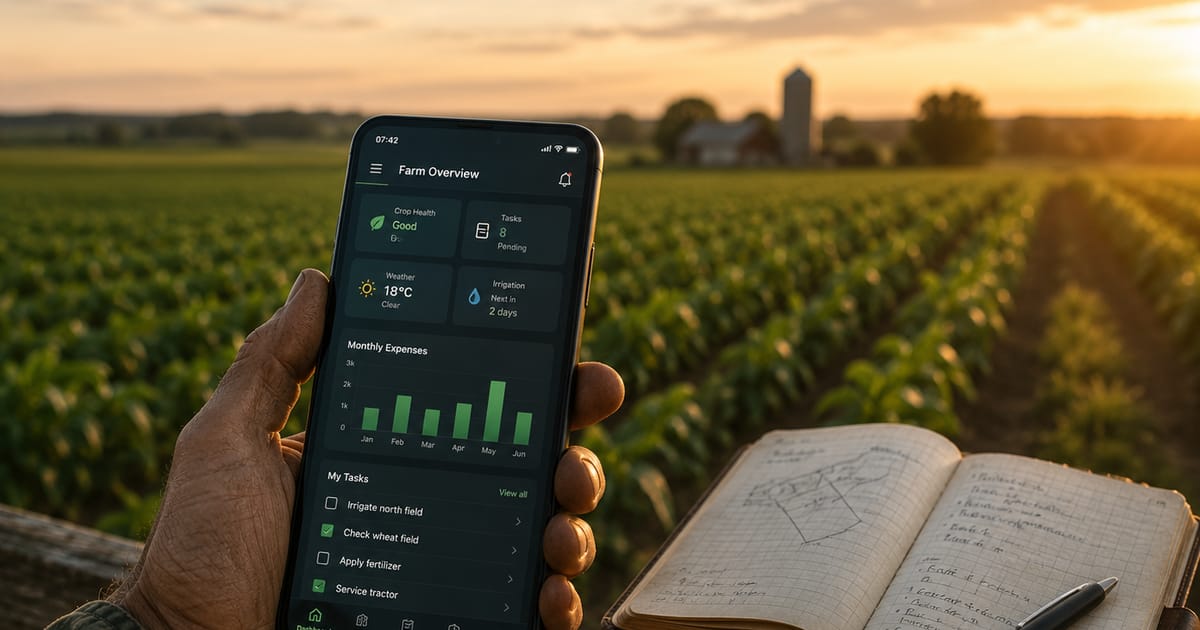
Ask most farmers what they spent on inputs last season, or which field was actually the most profitable, and the honest answer is often "somewhere around" or "I'd have to go look." That's not a character flaw — it's what happens when records live across notebooks, receipts in a drawer, and memory. Good record keeping fixes that, and it pays for itself well beyond compliance.
What to actually track
Records only help if they cover the things you'll actually need to answer later. At minimum:
- Field and crop history — what was planted where, when, and what happened to it (treatments, irrigation, observed issues) through the season.
- Tasks and treatments — what was done, when, and by whom, including pesticide/fertilizer applications with product name, rate, and date. This is also what makes a re-entry or pre-harvest interval enforceable — you can't respect an interval you didn't record the start of.
- Harvests — yield per field, so you can compare seasons and fields on the same basis.
- Income and expenses, tied to a field or crop where possible. A total profit/loss number for the whole farm hides which specific field or crop actually earned it — or lost it.
- Inventory — what you have on hand, with expiry dates for anything time-sensitive, so you're not discovering a shortage or an expired product at the worst possible moment.
- Equipment maintenance — what was serviced, when, and what it cost, so you can spot a machine that's becoming more expensive to keep than to replace.
- Livestock health and production records, where applicable — treatments, vaccinations, and output over time.
Why it actually pays off
Record keeping isn't just for the tax season or an inspection. Three concrete payoffs show up within a season or two:
- You find out which fields and crops are actually profitable. Per-field, per-crop profitability — income minus the costs actually attributable to that field — regularly surprises people, in both directions. A field that "feels" productive can be quietly unprofitable once real input costs are counted against it.
- You catch problems earlier. An inventory expiring in three weeks, a piece of equipment due for maintenance, or a treatment that's overdue only shows up as an alert if something is actually tracking it — otherwise it shows up as a surprise.
- You have a defensible record if anyone ever asks. Whether it's a certification audit, a buyer asking about treatment history, or your own future self trying to remember what happened, dated records beat memory every time.
Why records usually fall apart — and how to actually keep up
The typical failure isn't lack of intent — it's friction. A notebook left in the truck, a spreadsheet that's a hassle to open in the field, a receipt that gets tossed before it's logged. Two things fix this in practice:
- Log it where you are, when it happens. A record you can add from your phone in the field, in under a minute, gets kept. One that requires sitting at a computer later doesn't.
- Make the record useful immediately, not just archived. If logging a treatment automatically feeds a re-entry interval countdown, or logging a harvest automatically updates that field's profitability, the record pays for itself the moment you enter it — not just at year-end.
FarmAssistance covers exactly this — fields, crops, tasks, livestock, inventory, equipment, and finances in one place, with real per-field and per-crop profitability calculated from what you log, and reports you can export as CSV or PDF whenever you need them.
Get the appIf pesticide or treatment records are part of what you're tracking, also see our guide to checking pesticide registration status before you log an application — the two go hand in hand.