FarmAssistance
Best Time to Spray Pesticides: A Practical Weather Checklist
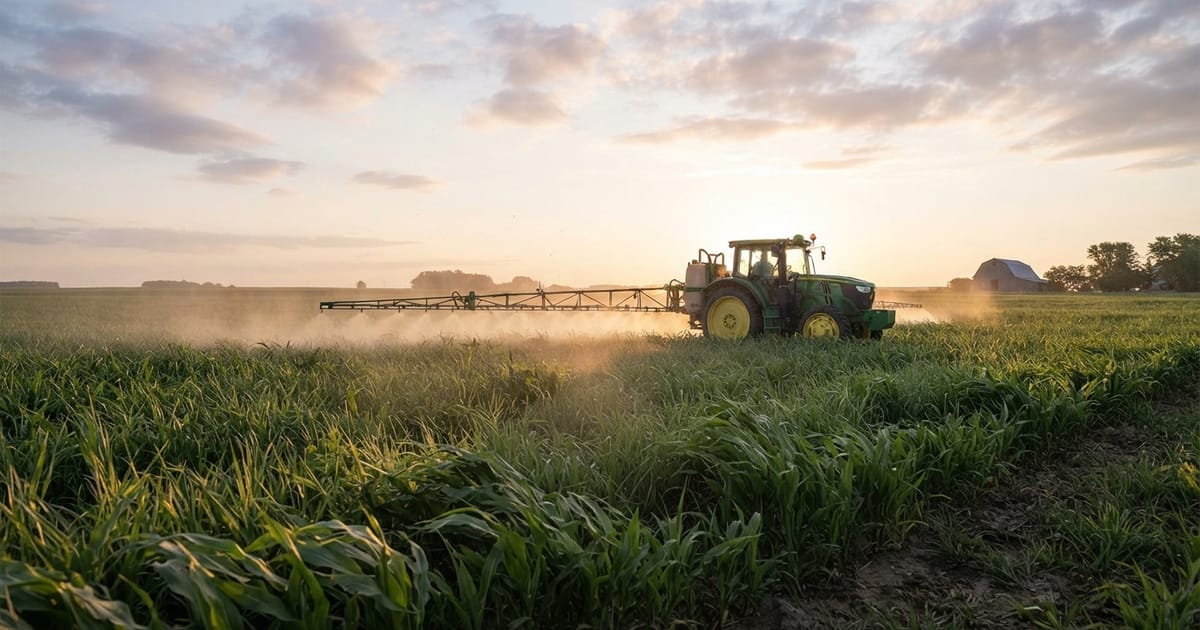
The right product, applied at the wrong moment, can still fail — drift onto a neighboring field, wash off before it works, or evaporate before it ever reaches the leaf. Spray timing isn't a formality; it's the difference between a treatment that works and one that's wasted money. Here's what actually matters, in order.
1. Wind speed
Wind is the single biggest driver of spray drift — the unwanted movement of droplets away from the target area, onto neighboring crops, waterways, or people. As a general rule of thumb used across most spray-drift guidance:
- Below roughly 3 km/h (2 mph): too still. Fine droplets can hang in the air and settle unevenly, or drift with whatever faint air movement exists once you've moved on.
- Roughly 3–15 km/h (2–9 mph): generally the usable range for most ground and boom applications, with lower droplet drift risk than either extreme.
- Above roughly 15–20 km/h (9–12 mph): drift risk rises quickly, and many product labels set their own explicit maximum — which always overrides general guidance.
The product label's own wind restriction is the legal requirement; general guidance like the above is only useful when the label doesn't specify a number.
2. Temperature and humidity
Hot, dry conditions cause fine spray droplets to evaporate before they reach the leaf surface — you can lose a meaningful share of your application to evaporation on a hot afternoon. As a practical guide, early morning and early evening tend to combine cooler temperatures with higher humidity, both of which favor droplets actually landing and staying where you put them.
Watch out for temperature inversions too — calm, still evenings where a layer of cool air settles near the ground under warmer air above. Inversions can trap fine spray particles near the surface and carry them long distances once even a light breeze picks up, well outside the field being treated. Dead-calm wind late in the day is not automatically a "good" spray window — check the actual forecast rather than assuming stillness means safety.
3. Rain — before and after
Most products need a minimum dry period after application before rain will wash them off without reducing effectiveness — this varies by product and is stated on the label. Before spraying, check the forecast for the hours immediately ahead, not just "is it raining right now." A clear sky at 8am with rain forecast for 11am can still ruin a 9am application if the product needed four dry hours to work.
4. A practical pre-spray checklist
- Check the product label's own wind, temperature, and rainfall restrictions first — they're legally binding and always take priority over general guidance.
- Check current wind speed and direction, not just the daily average — conditions change through the day.
- Check the forecast for the next several hours, not just right now, for both wind and rain.
- Avoid spraying during a temperature inversion, even if it feels calm.
- Prefer early morning or early evening over the middle of a hot, dry afternoon when practical.
- Confirm the product is still currently authorized for your crop before you use it — see our guide on checking pesticide registration status.
FarmAssistance pulls a real current forecast for your exact field location — wind, rain, and heat — so you can check spray conditions against the actual forecast for your farm, not a regional average from a general weather app.
Get the appDon't forget re-entry and harvest intervals
Timing isn't only about the moment of application. Most products also carry a re-entry interval (how long before people can safely go back into the treated area) and a pre-harvest interval (how long before you can harvest a treated crop). Both are on the label, both are legally binding, and neither shows up in a weather forecast — plan them in alongside the spray window itself.